This page answers:
- Under what circumstances can an employer terminate an employee?
- How many days in advance should the employer notify the worker?
- How to calculate severance pay in Taiwan?
According to the Labor Standards Act, the employer can terminate the labor contract when the employer “cannot continue to hire the worker” or “the worker causes harm to the employer”. As long as the statutory reasons for termination described below are met, and the statutory termination procedures are followed, it is a legal dismissal; if there is no legal reason for termination but the employee is dismissed without authorization, it is an illegal dismissal.
1. Situations in Which an Employer May Dismiss an Employee with Advance Notice and Severance Pay
Employers can dismiss workers with advance notice for the following reasons (Article 11 of the Labor Standards Act):
- Business Suspension or Transfer: If the employer’s business is suspended or transferred to another company (e.g., through acquisition).
- Operating Losses or Contraction: If the employer’s business faces significant operating losses or contraction (e.g., continuous losses over several years).
- Force Majeure: If a natural disaster or other uncontrollable event (e.g., a major earthquake or flood) causes the business to suspend operations for more than one month.
- Business Restructuring: If the nature of the business changes, requiring a reduction in labor, and no suitable positions are available for reassignment.
- Incompetence: If the employee is no longer competent for the job or unable to perform the required duties effectively.
Dismissal should be the last resort. Taiwan courts generally expect the employer to have tried other measures first, such as training, warnings or reassignment to a suitable position, especially when dismissing for incompetence. Keep records of performance reviews and of the steps you took.
When an employer terminates a labor contract pursuant to the above reasons that can attribute to the employer, the employer should give the below minimum period of advance notice, according to Article 16 of the Labor Standards Act:
Termination notice
| Continuous service | Advance notice |
|---|---|
| 3 to 12 months | 10 days |
| 1 to 3 years | 20 days |
| More than 3 years | 30 days |
If the employer does not give the required notice, it must pay the wages for the notice period instead. During the notice period, the employee may take paid leave to look for a new job, up to two working days per week (Article 16 of the Labor Standards Act).
In addition to the notice period, the employer is also required to pay severance pay when the dismissal can be attributed to the employer.
Severance pay
According to Article 12 of the Labor Pension Act, an employer is liable to pay severance pay within 30 days after the employment contract has been terminated. Service years that remain under the old pension system are paid under Article 17 of the LSA instead (one month’s average wage for each year of service, with no cap). This applies to service before July 1, 2005 for Taiwan nationals, and to service before January 1, 2026 for foreign professionals without APRC (or all of their service, if they chose in writing by June 30, 2026 to stay under the old system). For service under the Labor Pension Act:
-
Severance pay is calculated at half a month’s average wage for each year of service, with a cap of six months’ wages total.
-
If an employee has worked for less than a year, the severance pay is calculated proportionally;
-
If an employee has worked for less than one month, the work time is considered one month.
Example: Worker A has an average wage of NTD 30,000 and has worked for 3 years 6 months and 15 days. The severance pay is about NTD 53,125.
Formula: 30,000 ×1/2 × { 3+〔(6+15/30)÷ 12 〕}=30,000 × (1+37/48) ≒53,124.9
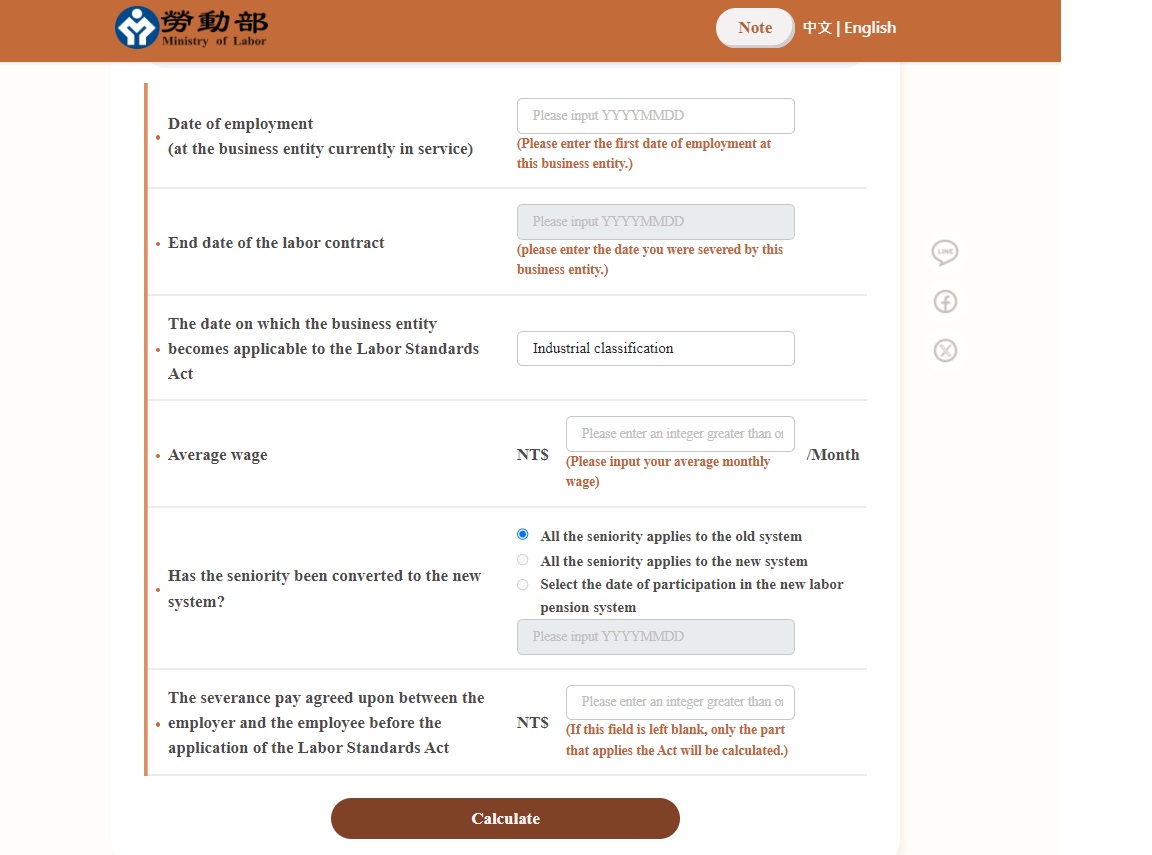
Online Severance Pay Calculator
Provided by Ministry of Labor
Report the dismissal to the authorities
When dismissing an employee under Article 11, the employer must report the employee’s name, job, reason for dismissal and other details to the local labor authority and the public employment service office at least 10 days before the employee leaves (within 3 days after the employee leaves if the dismissal is caused by force majeure). ~Article 33 of the Employment Service Act
2. In any of the following situations, an employer may terminate a labor contract without advance notice
Under Article 12 of the Labor Standards Act:
- Misrepresentation During Contract Signing: If the employee misrepresented any information when signing the labor contract, misleading the employer and causing damage.
- Violence or Insult Toward Employer or Colleagues: If the employee commits violence or seriously insults the employer, the employer’s family, an agent of the employer, or a co-worker.
- Imprisonment: If the employee is sentenced to temporary imprisonment in a final judgment without suspension or the option to pay a fine.
- Serious Breach of Contract or Work Rules: If the employee seriously breaches the labor contract or violates work rules.
- Damage to Employer’s Property or Disclosure of Confidential Information: If the employee deliberately damages or misuses the employer’s property, machinery, or tools, or discloses confidential or technical information, causing harm to the employer.
- Unjustified Absence: If the employee, without valid reason, is absent from work for three consecutive days or a total of six days in a month.
If the dismissal is based on the above 1~6, no prior notice is required and no severance pay is required.
Act within 30 days. For reasons 1, 2, 4, 5 and 6, the employer must terminate the contract within 30 days of learning the facts (Article 12, paragraph 2). After that, the employer can no longer dismiss on that ground. Reason 3 (imprisonment) is not subject to this time limit.
3. When an Employer May Not Dismiss
Under Article 13 of the Labor Standards Act, an employer may not terminate the contract while the employee is:
- on maternity leave under Article 50, or
- receiving medical treatment for an occupational injury or illness under Article 59.
The only exception is when a natural disaster, accident or other force majeure makes it impossible to continue the business, and the competent authority approves.
4. What to Settle When Employment Ends
- Wages and overtime owed up to the last day of work.
- Unused annual leave: the employer must pay wages for the days not taken (Article 38, paragraph 4).
- Notice-period wages and severance pay, where they apply (see section 1).
- Certificate of service: if the employee asks for one, the employer may not refuse (Article 19).
5. When the Employee Resigns
- Notice: an employee on an indefinite-term contract must give the employer the same advance notice as in Article 16, that is 10, 20 or 30 days depending on length of service (Article 15, paragraph 2).
- Leaving without notice: an employee may terminate the contract immediately if, for example, the employer misrepresented facts when signing the contract, committed violence or serious insult, did not pay wages as agreed, or breached the contract or labor laws in a way that may harm the employee. In these cases the employer must still pay severance pay (Article 14). For misrepresentation and for breaches of the contract or labor laws, the employee must act within 30 days of learning the facts, or of learning of the resulting harm.
Links go to the English translation on the Laws & Regulations Database of the Republic of China (Taiwan). If a translation differs from the Chinese text, the Chinese text prevails.