Taiwan subsidiaries of foreign groups commonly pay three kinds of technology and brand fees overseas:
- license fees for the parent’s patents or manufacturing processes
- trademark royalties for using the group brand
- patent or know-how fees paid to an offshore affiliate, based on sales or a fixed amount
Because the rights are used in Taiwan, these payments are Taiwan-source income under Article 8(6) of the Income Tax Act. The Taiwan payer must withhold tax at source (Article 88) at 20% (Article 3 of the Standards of Withholding Rates for Various Incomes). The exception is a royalty approved for exemption under Article 4(1)(21) of the Income Tax Act: the foreign licensor pays no Taiwan income tax, and the Taiwan company withholds nothing.
Until recently, the review rules set no filing deadline. Many groups simply paid under the contract, waited until the technology was in use, and applied for the exemption afterwards with evidence of the production benefits.
That approach no longer works for applications filed on or after 13 May 2026.
What changed: the filing window now opens and closes with the contract
On 13 May 2026, Taiwan’s Ministry of Finance and Ministry of Economic Affairs jointly amended the review principles for royalty and technical service fee exemptions (外國營利事業收取製造業技術服務業與發電業之權利金及技術服務報酬免納所得稅案件審查原則), effective the same day. The application still has two stages, as Article 8-7 of the Enforcement Rules of the Income Tax Act requires: approval from the competent industry authority first, then an application to the tax office. Each stage now has a deadline.
- Project approval from the Industrial Development Administration (IDA), MOEA (the Energy Administration for power generation): file after the contract is signed and before it takes effect, or at the latest while the contract is still in force.
- Exemption application to the local National Taxation Bureau: file within 2 months from the day after the IDA approval letter is issued, with the approval letter and supporting documents.
The filing date also sets how long the exemption lasts:
| When you file with the IDA | Approved exemption period |
|---|---|
| After signing, before the contract takes effect | 3 years from the contract’s effective date |
| After the contract takes effect | 3 years from the filing date |
| License or plant-construction period under 3 years | The actual period, never beyond the contract term |
| Renewal filed before the previous period ends | 3 years from the day after the previous period ends |
Only royalties that the Taiwan company books as an expense (on an accrual basis) within the approved period are exempt.
In short: the exemption is now a pre-signing planning item, not a post-payment formality. File after the effective date and every royalty accrued before your filing date is taxable. Miss the 2-month window at the tax office and the whole exemption may be lost.
Application process
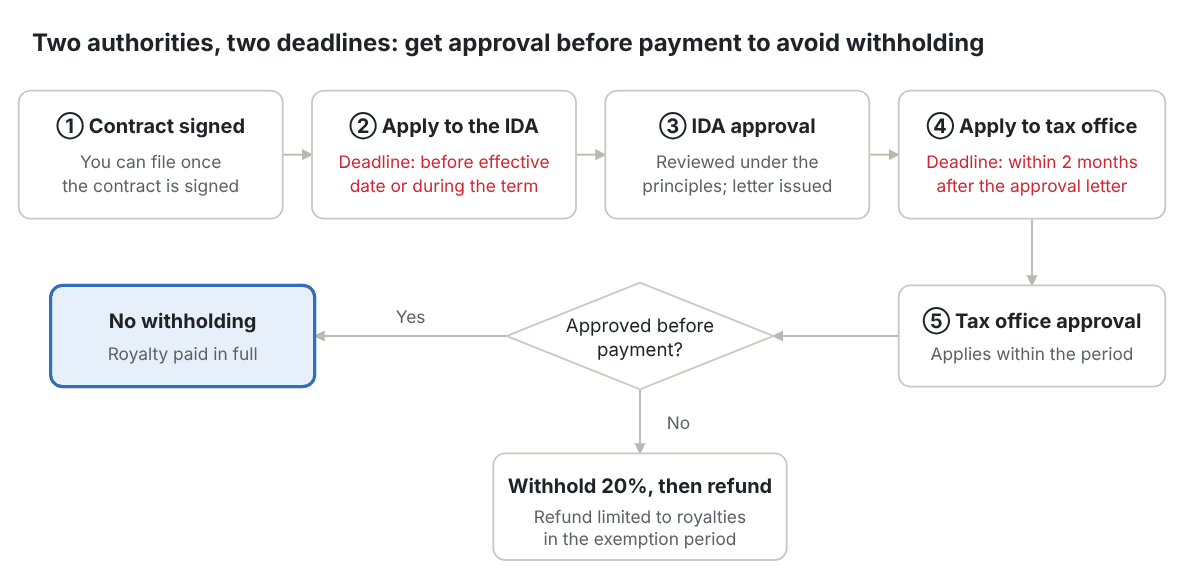
The IDA and the tax office each impose a deadline, and missing either one means no exemption. If a payment falls due before the tax office has approved the exemption, the Taiwan company must still withhold 20% and claim a refund afterwards. Refunds cover only royalties within the approved exemption period.
The IDA was formerly the Industrial Development Bureau (工業局). Older guidance that mentions a “tax exemption certificate from the Industrial Development Bureau” refers to what is now the IDA approval letter.
How much is at stake
On a 3-year license at NT$10 million a year, Taiwan withholding tax can range from zero to NT$6 million.
Assumptions: a US parent licenses patented technology to its Taiwan subsidiary for 3 years at NT$10 million a year. Taiwan and the US have no income tax treaty in force, so without the exemption, royalties are withheld at 20%.
| Scenario | Taiwan withholding tax | Parent receives over 3 years |
|---|---|---|
| Filed with the IDA before the effective date; tax office application within 2 months of approval | 0 | NT$30 million |
| Filed 3 months after the effective date | NT$0.5 million (20% of the NT$2.5 million accrued in the first 3 months) | NT$29.5 million |
| No application, or either deadline missed | NT$2 million a year, NT$6 million in total | NT$24 million |
If the contract requires the parent to receive royalties net of Taiwan tax, the Taiwan company bears the tax and must gross up the payment: NT$10 million ÷ (1 − 20%) = NT$12.5 million a year. The tax rises to NT$2.5 million a year, or NT$7.5 million over 3 years.
The technology, the contract and the eligibility are identical in all three scenarios. The only difference is when the application was filed.
Additional rules for intra-group licenses
Licenses from an overseas parent or IP holding company to a Taiwan affiliate tend to involve large amounts and group-standard terms. Besides the filing deadlines, check each of the following:
- 15% minimum tax rule (Point 11 of the review principles, new): if the statutory income tax rate on the royalty in the licensor’s home jurisdiction is below 15%, the exemption is not available. Groups that hold IP in a low-tax jurisdiction may be excluded even if the technology qualifies. Applications filed with the IDA before 13 May 2026 are not subject to this rule.
- Eligible industries (Point 5, paragraph 3): limited to 21 industries. The amendment added hydrogen fuel cells, aviation and drones, and shipbuilding, and removed smart living and information services.
- Trademark royalties: the trademark must be registered with Taiwan’s Intellectual Property Office and must appear side by side with the Taiwan company’s own trademark on the goods or services. Royalties for products sold under the foreign brand alone do not qualify.
- Know-how: technology without patent registration rarely qualifies in practice and must be checked case by case against the scope of the review principles.
- Own use: the Taiwan licensee must use the technology in its own production. Technology passed on to an overseas affiliate for production, or used only for R&D, does not qualify.
- Transfer pricing (Point 11): even when exempt, royalties paid to a related party must be at arm’s length under Taiwan’s transfer pricing regulations. Any excess over an arm’s-length amount cannot be deducted as a cost or expense.
Songjer CPA’s view
Groups that lose this exemption usually understand the rules. The problem is sequencing. Cross-border licenses are typically negotiated by headquarters or the legal team, and the Taiwan finance team often sees the contract only when the first invoice arrives. Under the old rules there was still time to fix that. Under the new rules, it can cost the entire exemption period.
What we recommend:
- Add a Taiwan tax check to contract review. Before signing, confirm the industry, the licensor’s home-country tax rate, and the patent or trademark registration status.
- Set the contract’s effective date after the signing date, leaving time to file with the IDA so the exemption covers the full contract term.
- Diary the 2-month tax office deadline the day the approval letter arrives, and prepare renewals before the exemption period ends.
- Review existing contracts. Any application filed on or after 13 May 2026 must now pass the 15% test and is limited by the remaining contract term.
- If the exemption is not available, consider the Article 25 deemed-profit regime for technical service fees (an effective withholding rate of about 3% once approved) or a reduced treaty rate where a tax treaty applies. See how treaty relief works in Taiwan dividend withholding tax reduction and tax treaty benefit applications.
The effective date you choose can matter more to the after-tax cost than the royalty rate you negotiate.
Legal references
| Regulation | Provision | What it covers |
|---|---|---|
| Income Tax Act | Article 4(1)(21) | Exemption for approved royalties and for technical service fees for plant construction by key productive enterprises |
| Income Tax Act | Article 8(6) | Royalties for patents, trademarks and similar rights used in Taiwan are Taiwan-source income |
| Income Tax Act | Article 88 | Withholding obligation on royalty payments |
| Standards of Withholding Rates for Various Incomes | Article 3 | 20% withholding on royalties paid to foreign enterprises without a fixed place of business in Taiwan |
| Enforcement Rules of the Income Tax Act | Article 8-7 | Approval by the competent authority first, then application to the tax office |
| Review principles for royalty and technical service fee exemptions (amended 13 May 2026) | Point 5(3), Point 11 and the new deadline provisions | Eligible industries, 15% minimum tax rule, transfer pricing, filing deadlines, exemption period, exempt amount, transitional rules (point numbers per the official gazette) |
| Regulations Governing Assessment of Profit-Seeking Enterprise Income Tax on Non-Arm’s-Length Transfer Pricing | — | Related-party royalties must be at arm’s length |
| Income Tax Act | Article 25 | Alternative: foreign technical service providers may be approved to treat 15% of revenue as taxable profit (effective withholding about 3%) |
Links go to the English translations on the Laws & Regulations Database of the Republic of China (Taiwan). If a translation differs from the Chinese text, the Chinese text prevails.
This article summarises the review principles as amended on 13 May 2026 and other public sources. It is general information, not advice on any specific case; the competent authorities’ decisions and the official legal texts prevail. All figures in the example are hypothetical.
Sources