When a foreign company sends engineers or consultants to Taiwan, the Taiwan customer normally withholds 20% from the service fee. If the foreign company’s home country has a tax treaty with Taiwan and the company has no permanent establishment (PE) in Taiwan, the fee is business profits under the treaty and can be exempted on application. Once the exemption is approved, the tax office tells the Taiwan customer not to withhold.
The trouble usually starts after approval. Many groups treat the approval letter as a standing pass: they sign another contract with the same customer, send the team back, and keep paying without withholding. But the approval only confirms that there was no PE for the contract and period in the application. Later contracts add to the days spent in Taiwan, and once the total crosses the threshold, even the exemption already granted can be reopened.
The approval covers the facts you filed
Under Article 23 of the Regulations Governing Application of Agreements for the Avoidance of Double Taxation with Respect to Taxes on Income (the “DTA Regulations”), a foreign enterprise claiming the business profits exemption files a certificate of residence, evidence that it has no PE in Taiwan, and income documents with the tax office where the payer is located. For income within the scope of Article 88 of the Income Tax Act, the tax office copies the approval to the withholding agent, who then does not withhold.
The tax office reviews the contract, people and days presented at the time. If the facts change, such as a new contract, a longer service period or more staff in Taiwan, the “no PE” conclusion has to be checked again. It does not carry forward simply because you hold an approval letter.
How the 183 days are counted
Most of Taiwan’s treaties have a service PE clause: if an enterprise furnishes services in Taiwan through employees or other personnel for more than a set number of days (commonly 183) in any 12-month period, it is treated as having a PE in Taiwan. Article 9 of the DTA Regulations sets out how the days are counted:
| Item | Rule |
|---|---|
| Which days count | Days physically present in Taiwan, from the day after arrival through the day of departure, including weekends, public holidays, leave, sick days and short work stoppages |
| Several people in Taiwan at once | Overlapping days are counted once: a day counts if anyone is in Taiwan |
| 12-month period | Any 12 consecutive months, not Taiwan’s tax year; the count does not reset at year-end |
| Preparatory work abroad | Days spent abroad that are closely connected with the Taiwan services may also be taken into account |
| Same or connected projects | Days are added together |
Article 9 lists four factors for deciding whether projects are connected:
- The projects fall under one master contract, or, under separate contracts, it was reasonable to expect further contracts with the same customer or its related parties when the first was signed.
- The work is of the same nature.
- The same individuals perform the services.
- Other facts showing a commercial connection between the projects.
Splitting one engagement into several purchase orders or annual contracts therefore does not restart the count.
Example
The following is a hypothetical example showing how days add up and what is at stake.
A Japanese company implements a production management system for a Taiwan customer, sending the same team of engineers:
| Contract | Period | Days in Taiwan (overlaps counted once) | Fee | Status |
|---|---|---|---|---|
| Contract 1: implementation | Aug–Dec 2025 | 110 days | NT$15 million | Business profits exemption approved; no withholding |
| Contract 2: additional features | Mar–May 2026 | 80 days | NT$8 million | Customer also did not withhold |
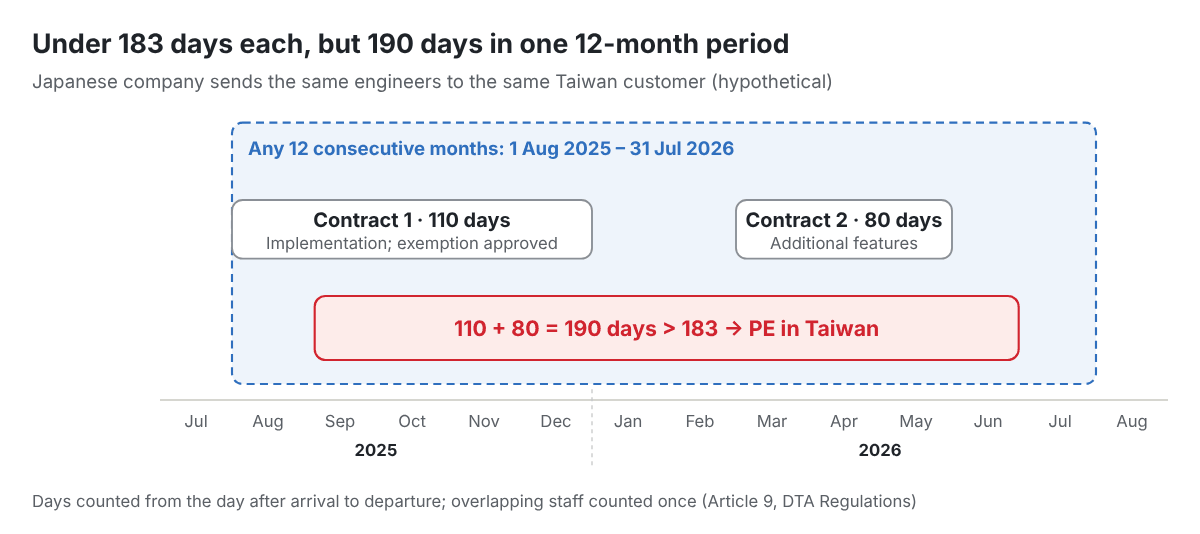
Neither contract reaches 183 days on its own. But the customer, the nature of the work and the people are the same, so the projects are connected. In the 12 months from 1 August 2025 to 31 July 2026 the total is 190 days, above the 183-day threshold in the Taiwan–Japan tax agreement, so the Japanese company has a PE in Taiwan.
Possible consequences:
- Contract 2 does not qualify for the business profits exemption. The customer must withhold NT$8 million × 20% = NT$1.6 million.
- The basis for the Contract 1 approval no longer holds. The tax office may require withholding of NT$3 million on the NT$15 million fee.
- Total tax to make up: NT$4.6 million. Under Article 114 of the Income Tax Act, a withholding agent that fails to withhold must pay the tax and file the withholding statements by a deadline, and may be fined up to 1 times the unwithheld tax; if it misses that deadline, the fine can reach 3 times.
If the fees were agreed net of Taiwan tax, the Taiwan customer effectively bears the cost, and the parties usually end up renegotiating who pays.
Thresholds differ by treaty
The number of days and the counting rules depend on the treaty, so do not assume 183 days in every case:
- Taiwan–Japan: a service PE arises after more than 183 days in any 12-month period.
- Taiwan–Australia: the threshold is 120 days. In a case published by the Taipei National Taxation Bureau, an Australian company argued its consultant spent fewer than 120 days in Taiwan. The bureau found the same person had entered on an Australian passport and a Taiwanese passport, for 130 days in total, and refused the exemption. Days on different passports held by one person are added together.
- Taiwan–Singapore (new agreement): applies from 1 January 2027 and adds a service PE threshold of more than 183 days in any 12-month period, which the old agreement did not have.
Beyond the threshold: 20% withholding is not the only outcome
A PE does not automatically mean tax on the gross fee. The earlier you plan, the more options you have:
- File on the profits attributable to the PE: under the treaty, Taiwan taxes only the profits attributable to the PE, which can be reported on actual profits rather than settled by withholding on gross fees.
- Income Tax Act Article 25: a foreign enterprise providing technical services can apply to the Ministry of Finance to treat 15% of revenue as taxable profit, an effective rate of about 3% of revenue (Article 25).
- Point 15-1 of the Taiwan-source income guidelines: where part of the services is performed outside Taiwan, the enterprise can apply to compute Taiwan-source income using its net profit rate and the share of profit contributed in Taiwan.
If tax has already been withheld and the treaty is later found to apply, Article 34 of the DTA Regulations allows a refund claim within 10 years of payment (5 years before the amendment of 8 April 2025). In the other direction, where too little tax was paid because the law was misapplied, the tax office can collect the shortfall from the withholding agent under Article 35.
Songjer CPA’s view
The problem is rarely the first contract. It is usually the second or third. Tax is normally reviewed before the first contract is signed. After approval, follow-on contracts and extensions are often handled directly by sales or project teams, and no one goes back to add up the days. By the time a tax audit or the next application reveals it, the unwithheld payments have become the Taiwan customer’s problem.
What we recommend:
- Keep one day count across contracts: track each person’s arrival and departure dates per customer (including its related parties) and check the total for any 12-month period at all times.
- Run the numbers before adding or extending a contract: decide whether the work is a connected project and whether the total will cross the threshold, then reapply or choose another route.
- Add tax clauses to the contract: require notice when days approach the threshold, and agree who bears any withholding that has to be made up.
- Switch routes early when the threshold will be crossed: applying under Article 25 or Point 15-1 before payment is far easier than making up withholding and then seeking a refund.
- Count by person, across passports: add up days for one person holding several passports and for people rotating through Taiwan, following Article 9.
An exemption approval confirms past facts. It does not guarantee the treatment of future contracts.
Legal references
| Regulation | Provision | What it covers |
|---|---|---|
| DTA Regulations | Article 9 | Counting service PE days, the 12-month period, adding together same or connected projects |
| DTA Regulations | Article 23 | Documents for the business profits exemption; withholding agent notified not to withhold |
| DTA Regulations | Article 34 | Refund claims for tax already withheld, within 10 years |
| DTA Regulations | Article 35 | Collection of underpaid tax from the withholding agent |
| Income Tax Act | Article 88 | Withholding obligation |
| Income Tax Act | Article 114 | Make-up withholding and fines for failure to withhold |
| Income Tax Act | Article 25 | Technical services: 15% of revenue deemed taxable profit |
| Guidelines on Taiwan-source income under Article 8 of the Income Tax Act | Point 15-1 | Taiwan-source income based on net profit rate and Taiwan profit contribution |
| Individual tax treaties | PE and business profits articles | Service PE thresholds (vary by treaty) |
Links go to the English translations on the Laws & Regulations Database of the Republic of China (Taiwan). If a translation differs from the Chinese text, the Chinese text prevails.
This article is based on public laws and tax office releases. It is general information, not advice on any specific case; the competent authorities’ decisions, the treaties and the official legal texts prevail. The example is hypothetical.
Sources
- Laws & Regulations Database: Regulations Governing Application of Agreements for the Avoidance of Double Taxation with Respect to Taxes on Income
- Taipei National Taxation Bureau case: days on different passports added together (Chinese, reposted by the Taipei Certified Bookkeepers Association)
- Commercial Times: key points of the new Taiwan–Singapore tax agreement (Chinese)