Taiwan and Singapore had not substantially revised their income tax agreement since it was signed in 1981. The new agreement was signed on 31 December 2025, entered into force on 13 February 2026 and applies from 1 January 2027, replacing the old one.
The changes affect two groups in opposite directions:
- Singapore companies investing in Taiwan: withholding tax on dividends, interest and royalties from Taiwan falls sharply.
- Taiwan companies with Singapore subsidiaries or regional headquarters: the indirect and deemed tax credits available under the old agreement are being phased out over three years, after which bringing Singapore profits back to Taiwan will cost noticeably more tax.
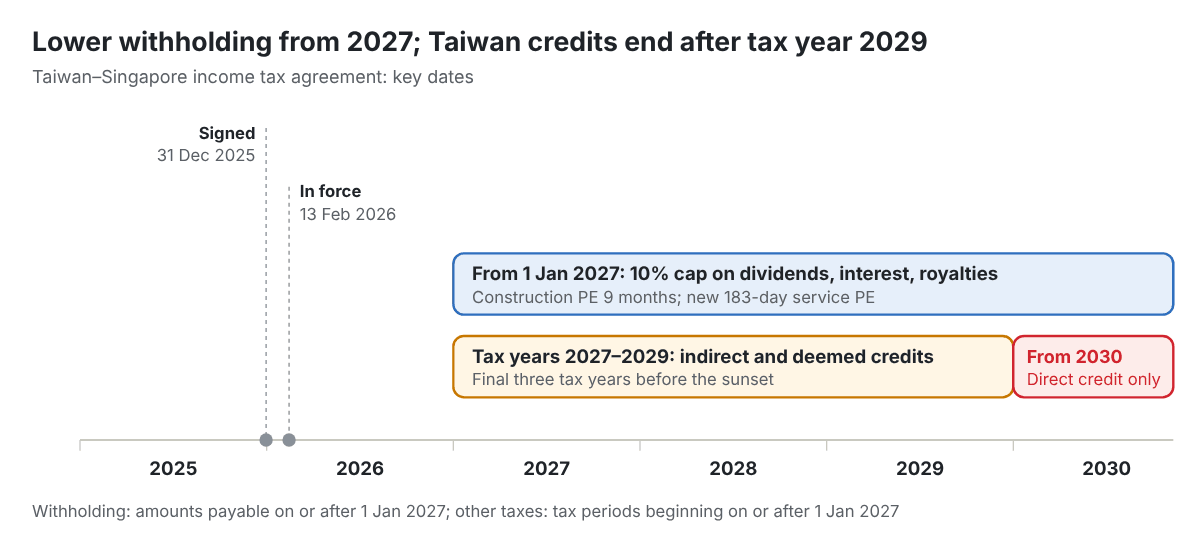
Timeline: when the rules start and stop
| Item | Date |
|---|---|
| Signed | 31 December 2025 |
| Entered into force | 13 February 2026 |
| Withholding taxes | Amounts payable on or after 1 January 2027 |
| Other taxes | Tax periods beginning on or after 1 January 2027 |
| Indirect and deemed tax credits (Taiwan side) | Only for corporate income tax returns for tax years 2027–2029; ended from tax year 2030 |
Dividends, interest and royalties paid during 2026 are still taxed under the old agreement and Taiwan’s domestic rates.
Singapore investors: a 10% cap across the board
For Singapore residents receiving Taiwan-source passive income, the withholding caps are:
| Income | Taiwan domestic rate (foreign enterprise without a fixed place of business) | Old agreement cap | New agreement cap |
|---|---|---|---|
| Dividends | 21% | 40% (above the domestic rate, so no benefit) | 10% |
| Interest | Generally 20% | None | 10%; exempt for specified entities listed in the agreement |
| Royalties | 20% | 15% | 10% |
Domestic rates: dividends under Article 4 of the Standards of Withholding Rates for Various Incomes; interest and royalties under Article 3.
Example: annual payments from a Taiwan subsidiary to its Singapore parent
The figures below are hypothetical.
| Payment | Amount | Withholding in 2026 | Withholding from 2027 | Annual saving |
|---|---|---|---|---|
| Dividend | NT$10 million | NT$2.1 million (21%) | NT$1 million (10%) | NT$1.1 million |
| Royalty | NT$5 million | NT$0.75 million (old cap 15%) | NT$0.5 million (10%) | NT$0.25 million |
| Interest on a parent loan | NT$3 million | NT$0.6 million (20%) | NT$0.3 million (10%) | NT$0.3 million |
| Total | NT$18 million | NT$3.45 million | NT$1.8 million | NT$1.65 million |
Dividends see the biggest drop, from 21% to 10%. Singapore groups that have built up retained earnings in a Taiwan subsidiary may want to revisit when to distribute them.
The cap does not apply automatically
Under Article 25 of the Regulations Governing Application of Agreements for the Avoidance of Double Taxation with Respect to Taxes on Income, a Singapore recipient can have the 10% cap applied at the time of payment only if it provides:
- a certificate of residence issued by the Inland Revenue Authority of Singapore (IRAS);
- evidence that it is the beneficial owner of the income;
- supporting documents: for dividends, proof of shareholding and the dividend calculation; for interest, the loan agreement and interest computation; for royalties, the licence agreement (with a Chinese translation) and the royalty calculation.
The Taiwan subsidiary, as withholding agent, must cite the treaty article and attach these documents when filing its withholding return. A Singapore company that is only a holding shell with no real operations may fail the beneficial ownership test and lose the reduced rate. Where interest is exempt under the agreement, approval must be obtained from the tax office first.
Permanent establishment thresholds have changed
- Construction PE: from more than six months within one year under the old agreement to more than nine months under the new one, which is more favourable for infrastructure, energy and plant installation projects.
- Service PE (new): a Singapore enterprise that sends staff to provide services in Taiwan for more than 183 days in total in any 12-month period has a PE in Taiwan, and the attributable profits are taxable in Taiwan. For how days are counted and when separate contracts are added together, see Treaty Exemption Approved in Taiwan? Later Contracts Can Still Create a Service PE.
Other changes worth noting
| Topic | New agreement |
|---|---|
| Management fees | The old agreement excluded income from management, control or supervision activities from “business profits”. The new agreement removes this exclusion, so group management fees may now qualify for the business profits exemption |
| Shipping and air transport | Profits from international shipping and air transport are exempt in the source country |
| Associated enterprises | A corresponding adjustment mechanism is added: when one side makes a transfer pricing adjustment, the other can adjust correspondingly through the mutual agreement procedure |
| Capital gains | New article: the source country may tax gains from immovable property, PE assets, and unlisted shares deriving most of their value from immovable property there; other gains are generally taxed only in the residence country |
Taiwan companies: three years left for credits on Singapore profits
A Taiwan company is taxed on its worldwide income. Under Article 3 of the Income Tax Act, foreign income tax paid can be credited, up to the additional Taiwan tax arising from including the foreign income.
The old agreement added two further credits:
- Indirect credit: Singapore corporate tax paid by the subsidiary on its profits can be credited, proportionally, against the Taiwan parent’s tax on the dividend.
- Deemed-paid (tax sparing) credit: tax the Singapore subsidiary did not pay because of Singapore tax incentives is treated as paid and can also be credited.
Article 23 of the new agreement keeps these two credits only for tax years 2027 to 2029. From tax year 2030, only the direct credit remains, covering tax actually paid in Singapore and borne by the Taiwan company itself. Since Singapore does not withhold tax on dividends, dividends from a Singapore subsidiary may in practice be taxed in Taiwan at the full 20% corporate income tax rate.
Singapore has also introduced a domestic top-up tax for large multinational groups within the global minimum tax rules, so subsidiaries on incentive rates may be topped up to 15% anyway. With both the incentive-rate advantage and the deemed credit shrinking, Singapore’s tax appeal as a regional headquarters for Taiwan groups is noticeably reduced.
Songjer CPA’s view
The effects arrive at different times: the benefits for Singapore investors start in 2027, while the cost for Taiwan groups only fully appears in 2030. Both sides should plan now rather than wait for the new rates or the sunset to arrive.
What we recommend:
- Singapore shareholders: schedule distributions for 2027 onwards. Earnings that do not need to be paid in 2026 may be worth making payable only on or after 1 January 2027, when the 10% cap applies. Confirm in advance how the resolution, record and payable dates will be treated.
- Singapore shareholders: prepare documents early. Certificates of residence are issued per year, and the beneficial ownership evidence and substance must hold up. Otherwise the Taiwan subsidiary has to withhold at 21% and the refund must be claimed afterwards.
- Taiwan groups: review retained earnings in Singapore subsidiaries. Consider repatriating in instalments during tax years 2027–2029 to use the last three years of indirect and deemed credits, and model the tax cost of keeping profits in Singapore versus bringing them home from 2030.
- Both sides: revisit cross-border contracts. Adjust royalty, loan, management fee and service contracts, and pricing, for the new rates and PE thresholds.
- Group structure: reassess Singapore’s role. A Singapore company that is only a holding or treasury entity without real operations will face closer beneficial ownership scrutiny under the new agreement.
Both the 10% cap and the three-year transition have fixed start and end dates. The earlier you set the timetable, the more options you keep.
Legal references
| Regulation | Provision | What it covers |
|---|---|---|
| Taiwan–Singapore income tax agreement (new) | Articles 5, 7–13, 23, 28 | Permanent establishment, business profits, shipping and air transport, associated enterprises, dividends, interest, royalties, capital gains, elimination of double taxation (including the credit sunset), effective dates |
| Standards of Withholding Rates for Various Incomes | Article 3 | Interest 20% (15% for certain instruments) and royalties 20% for foreign enterprises without a fixed place of business |
| Standards of Withholding Rates for Various Incomes | Article 4 | 21% withholding on Taiwan dividends paid to foreign enterprises |
| Regulations Governing Application of Agreements for the Avoidance of Double Taxation with Respect to Taxes on Income | Article 25 | Documents for applying treaty caps: certificate of residence, beneficial ownership, income computation; approval required for exempt interest |
| Income Tax Act | Article 3 | Worldwide taxation and the foreign tax credit limit |
Links go to the English translations on the Laws & Regulations Database of the Republic of China (Taiwan). If a translation differs from the Chinese text, the Chinese text prevails.
Treaty article numbers are based on public sources; the official text of the agreement prevails. This article is general information, not advice on any specific case; the competent authorities’ decisions and the official texts prevail. All figures in the example are hypothetical.
Sources
- National Taxation Bureau of the Northern Area, Ministry of Finance: three key changes under the new Taiwan–Singapore agreement (Chinese)
- Ministry of Finance Singapore: Tax Agreement Between the Singapore Trade Office in Taipei and the Taipei Representative Office in Singapore Enters into Force
- IRAS: list of Singapore’s tax agreements and agreement texts
- Laws & Regulations Database: Regulations Governing Application of Agreements for the Avoidance of Double Taxation with Respect to Taxes on Income